Residue-Free Honey with Gas-Based Varroa Control: Israel Field Trial Results
Abstract
ToBe Influencing Innovation, in collaboration with the Israeli Ministry of Agriculture and leading commercial beekeepers, conducted a field study to evaluate HiveMaster’s gas-based Varroa treatments during the honey flow. Unlike conventional strip methods, which are banned during nectar collection due to residue risks, HiveMaster disperses acaricides in precise gas pulses, using up to 90% less compound. The trial tested whether Varroa levels could be suppressed while honey supers were present, without leaving detectable residues in honey. Results show strong efficacy, residue levels far below regulatory thresholds, and practical feasibility for mid-season treatments.
Methods
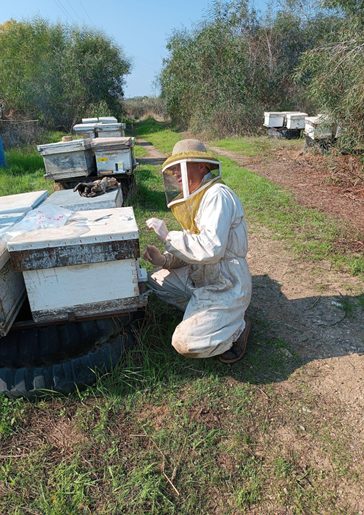
The study was conducted at two apiaries in two different geographical conditions: Nitzanim and Dalia.
Colonies were divided into three groups:
- HiveMaster treatment – 7 colonies received 15-day automated gas-phase amitraz treatments (476 mg per hive).
- Strip treatment – 7 colonies treated with three amitraz strips per hive (1800 mg per hive).
- Control – 6 colonies with low baseline infestation, untreated during the honey flow.
To minimize background contamination, fresh wax combs (previously unexposed to amitraz) were inserted into honey supers. Honey samples were collected at extraction and analyzed for residues at Intertek Laboratories in Germany.
- Regulatory maximum residue limit (MRL): 0.2 mg/kg amitraz in honey.
Varroa infestation was monitored by standardized alcohol washes of ~1,000 bees per hive before and after treatment. Colony strength was assessed by brood and bee frame counts throughout the season.
Results
Varroa control during honey flow
- HiveMaster maintained mite levels below the economic threshold (<3 mites/100 bees) even with honey supers in place.
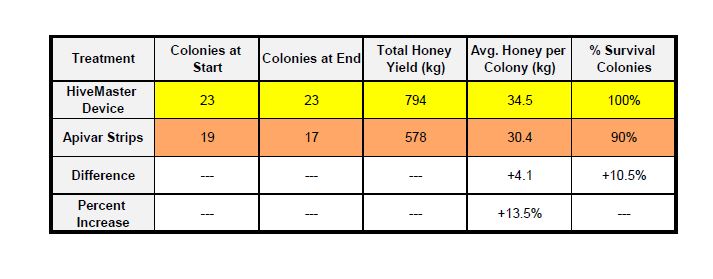
- Colonies remained strong and productive, with no negative impact on honey yield.
Residues in honey
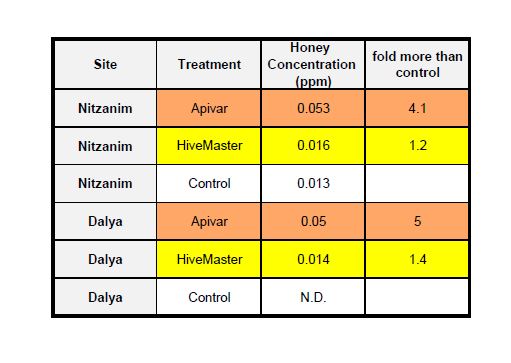
- HiveMaster: 0.014–0.016 mg/kg
- Strips: 0.05–0.06 mg/kg
- Control: Nitzanim ~0.013 mg/kg; Dalia N.D. (none detected)
All values were well below the MRL of 0.2 mg/kg.
Residues found in HiveMaster-treated colonies were comparable to untreated controls and mainly explained by wax contamination and metabolite carryover, not the treatment itself. After neutralizing this background factor, HiveMaster’s effective contribution was negligible — about 0.02 mg/kg, or one-tenth of the allowable limit.
Conclusion
This collaborative study with the Israeli Ministry of Agriculture demonstrates that HiveMaster enables safe and effective Varroa treatments during honey flow, where traditional methods cannot be used:
- Maintains mite levels below critical thresholds without interrupting nectar collection.
- Honey remains residue-free for all practical purposes, with levels 3–4x lower than strip treatments and one-tenth of the regulatory limit.
- Colony strength and productivity remain unaffected, confirming HiveMaster’s safety.
Implications
HiveMaster offers a breakthrough solution for commercial beekeeping:
- Enables mid-season “maintenance treatments” to prevent infestation spikes.
- Protects both colony health and honey market value by ensuring premium, residue-free honey.
- Provides regulators with clear evidence that gas-phase, precisely dosed acaricide treatments can be integrated safely into honey production cycles.
Other Articles from ToBe

Gas-Based Tropilaelaps Control with HiveMaster: Thailand Field Trial Results
Abstract In collaboration with Burapha University (BUU) in Bangsaen, Thailand, ToBe Influencing Innovation conducted a pilot study to evaluate HiveMaster’s gas-based treatments against Tropilaelaps mites. These mites, originating from the

Gas-Based Varroa Control with HiveMaster: Florida Field Trial Results
Abstract ToBe Influencing Innovation, in cooperation with Wonderful Bees in Florida, conducted a field trial to test the HiveMaster device for gas-based Varroa mite control. The study compared HiveMaster’s precision