Gas-Based Tropilaelaps Control with HiveMaster: Thailand Field Trial Results

Abstract
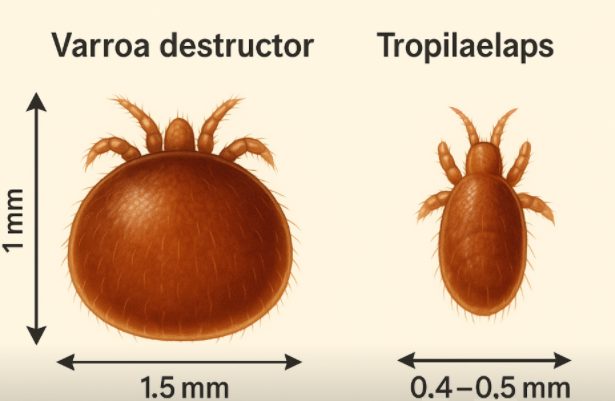
In collaboration with Burapha University (BUU) in Bangsaen, Thailand, ToBe Influencing Innovation conducted a pilot study to evaluate HiveMaster’s gas-based treatments against Tropilaelaps mites. These mites, originating from the Asian giant honey bee (Apis dorsata), reproduce three times faster than Varroa and can cause colony collapse within months. Conventional strip-based treatments are ineffective due to the absence of a phoretic phase. This first-of-its-kind trial tested HiveMaster’s ability to reduce Tropilaelaps infestations in commercial colonies, using both amitraz and fluvalinate as active molecules, with highly promising results.
Background
Tropilaelaps mites represent an escalating global threat. Unlike Varroa, they do not remain on adult bees for extended periods but move rapidly across combs and into brood cells, rendering contact-based strip treatments ineffective. Infestations spread quickly, transmit viruses, and can devastate colonies within 3–6 months. No fumigation trials had been conducted previously; thus, ToBe partnered with BUU to explore HiveMaster’s potential as a gas-based control solution using two widely available acaricides.
Methods
The study was conducted at BUU’s apiary in Bangsaen, Thailand. Colonies with high Tropilaelaps infestations were treated with HiveMaster devices programmed to deliver controlled pulses of active compound daily over a 15-day period.
- Active compounds: Treatments were conducted with both amitraz and fluvainate, two commercially available acaricides.
- Monitoring: Sticky boards were installed under hives to capture fallen mites, which were counted daily.
- Data collection: BUU students and staff supported sampling and logging of mite drop throughout the trial.
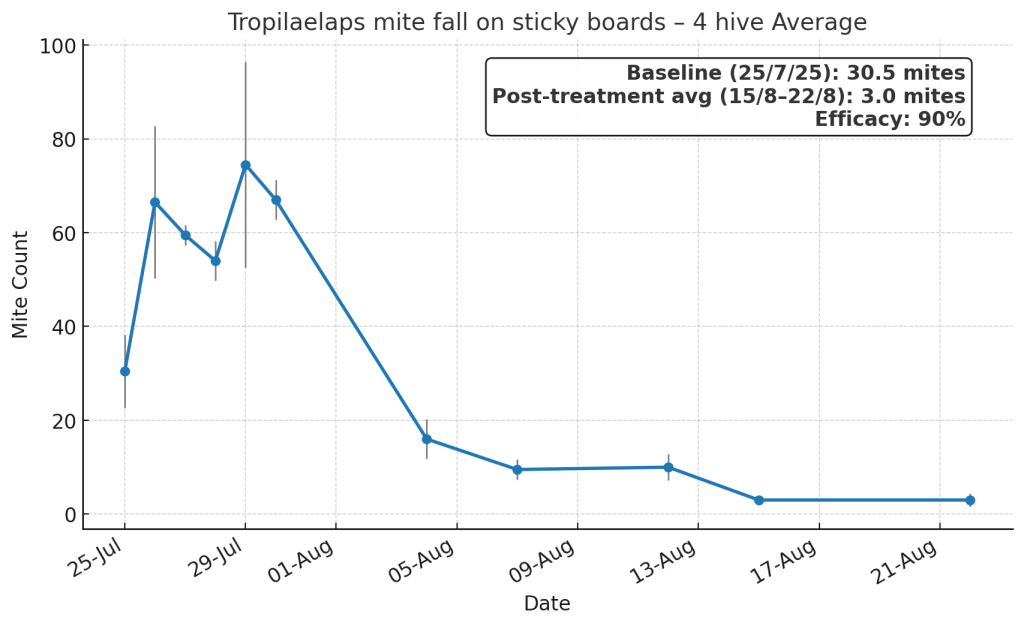
- Baseline: Pre-treatment counts averaged 30.5 mites per hive (July 25).
- Sample size: Results represent the average of four experimental hives.
Results
- A rapid spike in mite drop occurred immediately after treatments began, demonstrating the high sensitivity of Tropilaelaps mites to gas-phase acaricides.
- Sustained daily mite fall was observed throughout the 15-day protocol, followed by a sharp reduction in infestation levels.
- By the post-treatment period (Aug 15–22), average mite drop had declined to 3.0 mites per hive, representing ~90% efficacy.
- Both Amitraz and Fluvalinate showed high effectiveness in reducing infestations.
- Colony strength indicators remained stable, confirming the safety of HiveMaster treatments.
Conclusion
This first pilot trial demonstrates HiveMaster’s strong potential in controlling Tropilaelaps mites, achieving rapid and substantial reductions where conventional strip methods fail. High efficacy was achieved with both amitraz and fluvalinate, proving the platform’s flexibility in supporting different compounds.
Future Directions
To further validate these findings, ToBe is preparing a larger-scale experiment that will expand the number of colonies tested and include an untreated control group. This next step will provide stronger statistical power, confirm long-term efficacy, and refine protocols for sustainable field application.
Other Articles from ToBe

Residue-Free Honey with Gas-Based Varroa Control: Israel Field Trial Results
Abstract ToBe Influencing Innovation, in collaboration with the Israeli Ministry of Agriculture and leading commercial beekeepers, conducted a field study to evaluate HiveMaster’s gas-based Varroa treatments during the honey flow.

Gas-Based Varroa Control with HiveMaster: Florida Field Trial Results
Abstract ToBe Influencing Innovation, in cooperation with Wonderful Bees in Florida, conducted a field trial to test the HiveMaster device for gas-based Varroa mite control. The study compared HiveMaster’s precision